

Professor Young-don Park’s Research Team of the White Bio Specialized Research Talent Development Project at Incheon National University Publishes Paper on Eco-Friendly Organic Gas Sensors in the Chemical Engineering Journal
- 글번호
- 415931
- 작성일
- 2025-12-03
- 수정일
- 2025-12-03
- 작성자
- 홍보과 (032-835-9490)
- 조회수
- 122
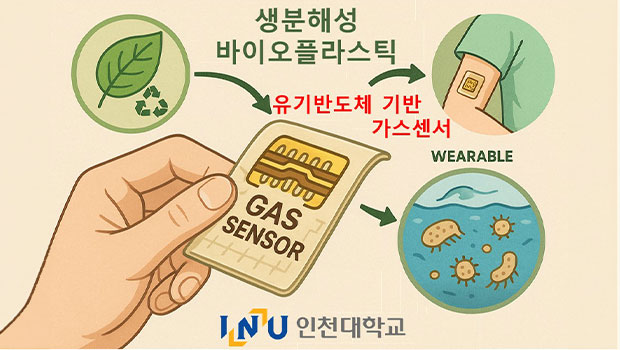
Organic semiconductor-based gas sensor using biodegradable materials
Incheon National University (President In-jae Lee) announced that the study conducted by Professor Young-don Park’s research team from the Department of Energy Chemical Engineering (Solvent-driven phase separation strategy for eco-friendly high-performance organic gas sensors) has been published in the world-renowned academic journal Chemical Engineering Journal (IF 13.2, top 3% in JCR).
Organic semiconductor-based gas sensors are suitable for wearable portable devices due to their flexible and lightweight characteristics, but because of their low stability, they are often used only once, which leads to increased waste and serious environmental pollution. In this study, the research team introduced 90% biodegradable polymer, improving both the performance of the gas sensor and the flexibility of the device. In particular, the study confirmed the biodegradability of the organic gas sensor caused by microorganisms in seawater, demonstrating that it is an eco-friendly electronic device.
The first author of this study, master’s student Seong-jin Kim, is currently completing majors in Energy Chemical Engineering and the White Bio Convergence Program. Based on the integrative knowledge of both majors, he combined an engineering approach to energy materials with biodegradable biomaterial technology, producing research results that led to the development of an eco-friendly organic gas sensor. Incheon National University is operating the White Bio Convergence Program together with Inha University, the Korea Polymer Research Association, and the Korea Conformity Laboratories (KCL) through the “White Bio Industry Specialized Research Talent Development Project,” supported by Incheon Metropolitan City and the Korea Institute for Advancement of Technology under the Ministry of Trade, Industry and Energy.
Kang Dong-goo, Director of the INU Industry–Academia Cooperation Foundation, stated that through the “White Bio Industry Specialized Research Talent Development Project,” the university is making efforts to cultivate specialized researchers in the eco-friendly white bio sector to help achieve Incheon Metropolitan City’s Carbon Neutrality 2045 goal and support Korea’s transition to a carbon-neutral society. He also stated that the university is actively promoting specialization in the advanced biomaterials field to replace the petrochemical industry.
In addition, Incheon National University is jointly operating carbon-neutral human resource development and industrial advancement programs linked to the “Strengthening Industrial Innovation Support for Carbon Neutrality” unit project under the RISE initiative promoted by Incheon Metropolitan City. Through this initiative, the university is promoting ▲ training of carbon-neutral materials research specialists (Master’s/Doctoral) through integrated undergraduate–graduate programs ▲ establishment of research-oriented educational facilities and expansion of experimental infrastructure ▲ development of undergraduate curricula related to the white bio industry and linkage with field training ▲ operation of ESG·SDG·carbon-neutrality–based capstone design programs, focusing on practical human resource development.
Director Kang stated, “By organically linking the White Bio Industry Specialized Research Talent Development Project and the RISE 2-② unit project, we will create a best-practice model of carbon-neutral industrial innovation where the regional industry and the university’s research and education ecosystem grow together.”
Meanwhile, Professor Young-don Park’s research team has been conducting active research, publishing 20 SCIE-indexed papers (16 as lead author) over the past three years.