

In 2026, Incheon National University Advances the Establishment of a Public Medical School, Continuing Strong Partnership with the Pan-Citizen Council
- 글번호
- 419926
- 작성일
- 2026-02-25
- 수정일
- 2026-02-25
- 작성자
- 홍보과 (032-835-9490)
- 조회수
- 669
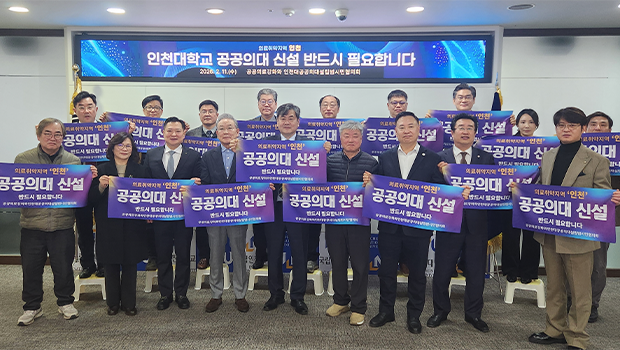
Pan-Citizen Council Urging the Establishment of a Public Medical School at Incheon National University
Full Support from the Pan-Citizen Council for the Public Medical School Model Research Project, Emphasizing that “Establishing a Public Medical School at Incheon National University Is Not an Option but a Necessity”
As a response to strengthening public healthcare and expanding essential medical services in medically underserved Incheon, the establishment of a public medical school at Incheon National University—reflecting the aspirations of 3 million Incheon citizens—continues to gain strong momentum this year with active participation from the Pan-Citizen Council for Strengthening Public Healthcare and Establishing a Public Medical School at Incheon National University (hereafter, the Pan-Citizen Council).
On February 2, 216 student government representatives from across the university participated in a signature campaign supporting the establishment of the public medical school, pledging collective commitment for the new semester. This was followed on February 4 by the signing of an MOU with Incheon Medical Center, creating new momentum for the establishment of the public medical school and the development of a strengthened public healthcare system in Incheon. Amid these developments, the participation of the Pan-Citizen Council has served as a decisive boost.
In particular, during a meeting held on February 11 between the university leadership and the Pan-Citizen Council, the council reaffirmed its full support and firm commitment to the establishment of the public medical school, generating an enthusiastic and determined atmosphere.
Fifteen executives from seven organizations affiliated with the Pan-Citizen Council’s executive committee—including the Incheon Love Movement Citizens’ Association, Incheon YMCA, Citizens’ Coalition for Economic Justice (Incheon branch), Incheon Metropolitan City Saemaul Association, Incheon Medical Center, Incheon Junior Club, and Incheon Peace and Welfare Solidarity—attended the meeting. Participants expressed deep concern over Incheon’s medical realities and reaffirmed that establishing a public medical school at Incheon National University is not optional but essential to address the urgent demands of 3 million citizens and the structural challenges facing this medically underserved region.
President In-jae Lee of Incheon National University stated during the meeting, “Establishing a public medical school is not merely about creating another medical college. It is a fundamental task of systematically training professionals who will take responsibility for essential regional healthcare and defining how a national university should contribute to its local community.” He added that he hopes the university and civic organizations will continue to respect each other’s roles and collaborate to strengthen public healthcare in Incheon.
Hwang Gyu-cheol, President of the Incheon Love Movement Citizens’ Association, remarked, “It is meaningful to once again gather with civic groups that share the same vision for the public medical school at Incheon National University.” He encouraged participants by expressing hope that 2026 would bring tangible achievements toward establishment and calling for a strong and united launch of joint efforts.
Kang Ju-su, Executive Director of Incheon Peace and Welfare Solidarity, emphasized, “Considering the characteristics of the five West Sea islands and border-adjacent areas, a public medical school at Incheon National University is absolutely necessary.” He added that efforts should be made to ensure that citizens’ aspirations for strengthening public healthcare are reflected in local election pledges and translated into concrete policy measures.
Jang Seok-il, President of Incheon Medical Center, stated, “Strengthening public healthcare in Incheon is directly connected to the establishment of a public medical school at Incheon National University,” and pledged that Incheon Medical Center would support medical education, clinical training, and residency programs as a teaching hospital once the school is established.
Additional discussions addressed the commissioning of a research project on the public medical school model, coordination with local governments and political stakeholders, strengthening regional campaigns, leading public discourse on the issue, and preparing strategic responses aligned with government policy directions.
Hong Jin-bae, Vice President for International Affairs and External Cooperation at Incheon National University, stated, “We will move beyond discussing the necessity of establishing a public medical school and, through a research project within this year, present a concrete blueprint outlining its model, functions, and roles. We will also accelerate efforts to expand networks with regional public healthcare institutions for clinical training and residency programs.”